

Mathematics at Sowerby
Mathematical Intent
Key Intentions: ‘Growing Courageous Learners’
At our school, mathematics is taught through a mastery approach, ensuring all children develop a deep, secure and connected understanding of mathematical concepts. Learning is carefully sequenced and builds progressively on the strong foundations established in the Early Years Foundation Stage, enabling children to revisit and strengthen key knowledge and skills over time.
Through varied and purposeful mathematical experiences, all children are supported to reason, make connections and articulate their thinking with confidence. This approach fosters positive mathematical attitudes, encourages risk-taking, and develops independent, inquisitive learners with secure foundations and a commitment to continual improvement.
Mathematical Implementation
EYFS
In Early Years, children’s understanding of number is developed through daily counting and subitising practice, ensuring all pupils build strong foundations from the outset. Teaching is inclusive and adaptive, using the Mastering Number programme to move flexibly from whole-class teaching to group and individual support as needed, supporting disadvantaged pupils and pupils with SEND. Learning is rooted in the CPA (concrete, pictorial, abstract) approach, allowing all children to access concepts in multiple ways while developing and using accurate mathematical vocabulary.
Planning draws on both NCETM and White Rose Maths guidance and is organised into two-week blocks to secure an in-depth understanding of each number. Teaching focuses on working deeply within a number, exploring value, shape, subitising, comparison, number bonds, operations, order and sequencing, pattern, problem solving, quantities and mathematical vocabulary. Key language is explicitly modelled, repeated and revisited to support understanding, particularly for children with additional needs or English as an additional language.
Teaching sequence: Daily counting and subitising, revisiting prior and linked learning, followed by the introduction of new concepts through practical, play-based and investigatory approaches. Children are encouraged to talk about their learning, explain their thinking and use mathematical language in context, supported by sentence stems and adult modelling. Reasoning and problem-solving opportunities are embedded across the week and linked to real-life contexts, including weight, height, measure, money and time.
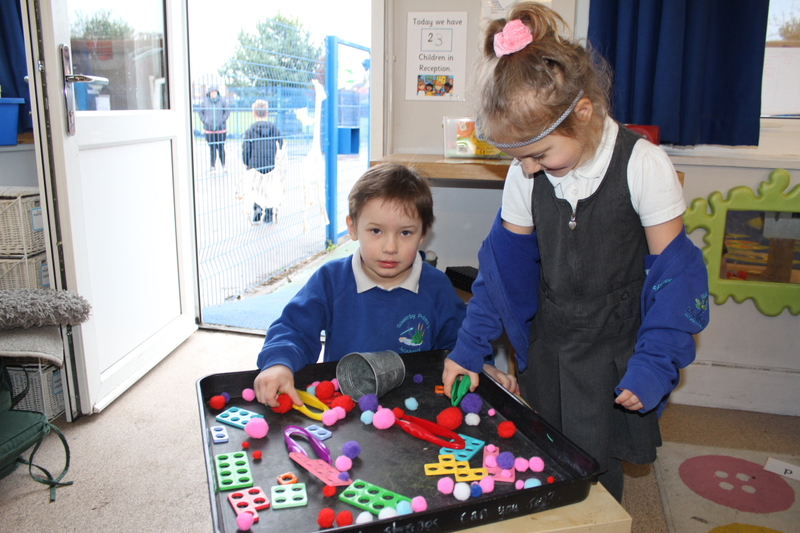
High-quality maths provision is evident across indoor and outdoor environments, providing opportunities for children to explore, apply and discuss mathematical ideas through play. Working walls display a range of representations and key vocabulary to support understanding of the weekly number and promote independent recall. Feedback is predominantly verbal and given in the moment to model precise language, address misconceptions and move learning forward.
Adaptive strategies, including KUNCU approaches such as pre-teaching and five-minute boxes, are used proactively to support children who need additional input, ensuring gaps in understanding and language development are addressed early.
Key Stage 1
In Key Stage 1, pupils follow White Rose Maths planning to ensure clear progression, while continuing to engage with Mastering Number to strengthen number sense and fluency. TT Rockstars is introduced to support the inclusive development of multiplication recall. Lessons are planned using the CPA approach and incorporate variation, reasoning and mathematical talk so that all pupils can access learning, articulate their thinking and be appropriately challenged.
Teaching sequence: Lessons begin with teacher modelling, including the explicit modelling of mathematical vocabulary and the use of stem sentences to embed mathematical concepts. This is followed by paired and supported practice, allowing pupils to rehearse language through talk and practical application, before moving to independent work. Tasks and representations are adapted to meet all learners’ needs (including pupils with SEND), ensuring support and challenge are embedded within lessons.
Working walls display modelled examples, key vocabulary, reasoning prompts and problem-solving strategies, supporting pupils to use precise mathematical language independently. Provision areas offer engaging and relevant tasks that encourage pupils to explain their thinking orally as well as in written form. Reasoning and problem-solving activities are embedded across the week, with pupils encouraged to justify answers using appropriate vocabulary. Maths areas include a wide range of manipulatives and resources that pupils confidently use to support understanding and talk through their thinking. Work is marked through a combination of teacher, peer and self-assessment, with verbal feedback used effectively to model correct language, clarify misconceptions and support progress.
KUNCU strategies, including pre-teaching, corrective teaching and five-minute boxes, are used adaptively to support pupils who need additional opportunities to develop fluency, understanding and mathematical vocabulary.
Key Stage 2
In Key Stage 2, pupils continue to follow White Rose Maths planning to ensure progression and coherence. TT Rockstars supports times table recall and the development of multiplicative thinking. Teaching continues to follow the CPA approach, enabling pupils to access learning through concrete and pictorial representations where needed, while developing abstract understanding and precise mathematical language over time.
Teaching sequence: Lessons include clear teacher modelling, supported practice and independent application. Teachers explicitly model reasoning, use of vocabulary and structured sentence stems, supporting pupils to explain, justify and critique mathematical thinking. Teaching is adaptive, with tasks, representations and questioning adjusted to meet the needs of all learners.
Working walls display modelled examples, reasoning strategies, problem-solving steps and key vocabulary to support pupils in using accurate language independently. Maths areas include a range of manipulatives and resources that pupils select confidently to support understanding and mathematical discussion.
Work is marked through teacher, peer and self-assessment, with verbal feedback used to refine pupils’ explanations, address misconceptions and deepen understanding. KUNCU strategies such as pre-teaching, corrective teaching and five-minute boxes are used to provide targeted opportunities for pupils to rehearse concepts and language, ensuring all pupils can keep pace with the curriculum.
Homework consolidates prior learning using a consistent structure: Last Week, This Week, Stickability Facts Practice, reinforcing fluency and vocabulary. Year 6 pupils use SATs practice materials, with additional booster sessions delivered weekly to address misconceptions, develop arithmetic fluency and strengthen mathematical reasoning and oracy.
Mastering Number
The Mastering Number programme is implemented across EYFS, Year 1 and Year 2 to develop a deep understanding of number composition and secure fluency in addition facts up to 20. Teaching places a strong emphasis on mathematical talk, with pupils encouraged to explain how numbers are composed and connected using accurate vocabulary.
In Key Stage 2, Year 4 and Year 5 follow Mastering Number at KS2, with Year 6 completing the Year 5 programme to consolidate understanding and address remaining gaps. Year 3 pupils follow the Claire Christie programme, consolidating addition facts in the Autumn term before transitioning to times table practice in the Spring term. Across all programmes, structured discussion and rehearsal of language support pupils in developing confidence, fluency and depth of understanding.