

History
Intent
At Sowerby Primary Academy, we want to develop a love of history and a curiosity about the past and how it has shaped the world that we live in. This is done throughout our broad and balanced curriculum which interests and intrigues learners whilst meeting and supporting the needs of all our children. Teaching of History at Sowerby Primary Academy is based on the aims and purposes outlined in the National Curriculum and has fidelity to the historical academic discipline.
Our curriculum is coherently planned and sequenced using the Elevate Progression Model to ensure that knowledge and disciplinary understanding build cumulatively from EYFS to the end of Key Stage 2. Alongside the National Curriculum and the Elevate Progression model, we aim to ensure that all children:
- know and understand the history of these islands as a coherent, chronological narrative, from the earliest times to the present day: how people’s lives have shaped this nation and how Britain has influenced and been influenced by the wider world
- know and understand significant aspects of the history of the wider world
- gain and deploy a historically grounded understanding of abstract terms such as ‘empire’, ‘civilisation’, ‘parliament’ and ‘peasantry’
- understand historical concepts such as continuity and change, cause and consequence, similarity, difference and significance, and use them to make connections, draw contrasts, analyse trends, frame historically-valid questions and create their own structured accounts, including written narratives and analyses
- understand the methods of historical enquiry, including how evidence is used rigorously to make historical claims, and discern how and why contrasting arguments and interpretations of the past have been constructed
- gain historical perspective by placing their growing knowledge into different contexts, understanding the connections between local, regional, national and international history; between cultural, economic, military, political, religious and social history; and between short- and long-term timescales.
We follow a carefully designed, knowledge-rich curriculum, underpinned by a progression of skills. Wherever possible, knowledge has been organised chronologically, to allow children to develop a clear chronological understanding of the past. The knowledge and skills build incrementally so that by the end of Key Stage 2 children can know, understand and apply the subject content taught, and be fully prepared (and excited) for their secondary school History learning.
We are committed to ensuring that all pupils, including those with Special Educational Needs and Disabilities (SEND) and those who may be disadvantaged, access the same ambitious History curriculum. Our expectations are high for every pupil. Through carefully considered adaptive teaching and the removal of barriers to learning, we ensure that all children develop secure historical knowledge and disciplinary understanding from their individual starting points. We aim to ensure that our history curriculum enables our children to be ambitious and courageous within lessons and that knowledge and skills taught and revisited supports children to both know more and remember more.
History is planned and delivered across a two-year cycle. This ensures progression of both knowledge and skills across each year group. Units are carefully sequenced with clear end points so that pupils build knowledge cumulatively and make meaningful connections to prior learning. Cross-curricular links can often be made within planning, for example, in upper Key Stage Two, within the Maya unit, links can be made to Geography with map work, writing linked with historical learning, telling mythical stories through dance and so on.
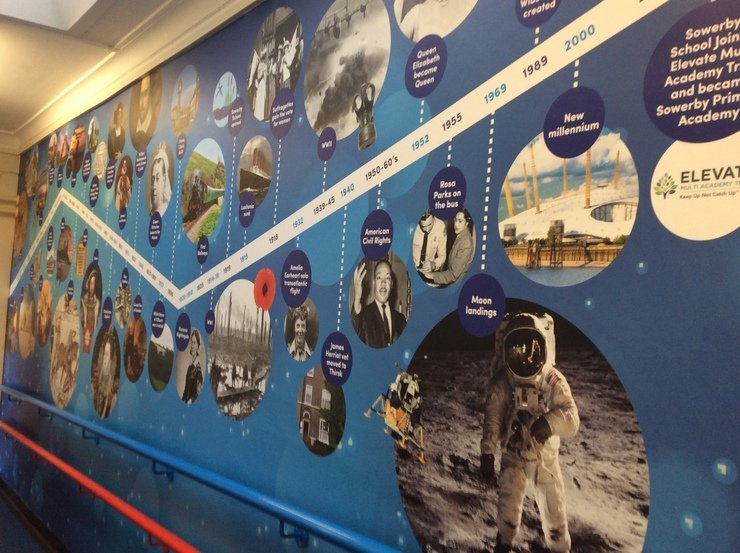
At the start of each history unit, there is a strong focus on chronology and the use of timelines which are on display in each classroom. Here, links to previous learning can be made to support retrieval practise. Links to geography can be made as children explore ‘when’ and ‘where’ in the world they are learning about and develop their coherent and concurrent historical understanding. Key vocabulary is discussed and explored with children and knowledge organisers are shared and referred to throughout units of learning to support understandings. Planned retrieval practice, including Flashbacks and low-stakes quizzes, strengthens memory and supports pupils to remember more over time. Through connected learning discussions, children are able to link their learning over time. Children use discussions to link their learning over time, noticing recurring historical themes (like settlement, food and farming, or monarchy) which helps them remember and build on what they’ve learned before.
Disciplinary knowledge is defined as learning how historians have studied and analysed the past, and how they have constructed and presented accounts of the past. The areas of disciplinary knowledge taught are called second-order concepts. Each history unit has one or two focus second-order concepts. Examples of this include ‘cause and consequence’ and ‘change and continuity’. These are taught through school and allow children to become confident with these concepts and build on their understandings as they move through school and become more confident historians.
Teaching focuses on checking understanding systematically. Teachers identify misconceptions, provide feedback and adapt teaching responsively so that pupils can keep up with the intended curriculum.
Children at Sowerby first experience History within the Early Years setting. This is as part of the ‘Understanding the World’ section of the EYFS framework.
By the end of EYFS, children will:
- Talk about the lives of the people around them and their roles in society.
- Know some similarities and differences between things in the past and now, drawing on their experiences and what has been read in class.
- Understand the past through settings, characters and events encountered in books read in class and storytelling.
Throughout KS1 and KS2 children have their own History book which moves with them throughout school. This massively supports their ability to recall on prior learning. It is always such a pleasure to hear the children talk about their learning and showing their favourite pieces of work, sometimes from years prior! The books include knowledge organisers at the start of a unit which include key vocabulary which will feature in lessons to help reduce cognitive load for the children and aid in their recall of key information. The organisers also include a timeline of events to support chronological understanding and a when appropriate, a map so children can see where in the world they are focussing their learning. There is also a space for them to make connections to prior learning in the subject, or linked subjects. Books demonstrate the children’s growing understanding of the subject knowledge and skills they have developed over their time at Sowerby.
Inclusion is central to our approach. Pupils with SEND and those who may be disadvantaged access the same ambitious curriculum as their peers. Adaptive teaching strategies can include pre-teaching key vocabulary, visual timelines, chunked instructions, scaffolded writing frames, modelled responses and flexible ways of recording learning where appropriate. Targeted adult support promotes independence and participation. High expectations are maintained for all pupils.
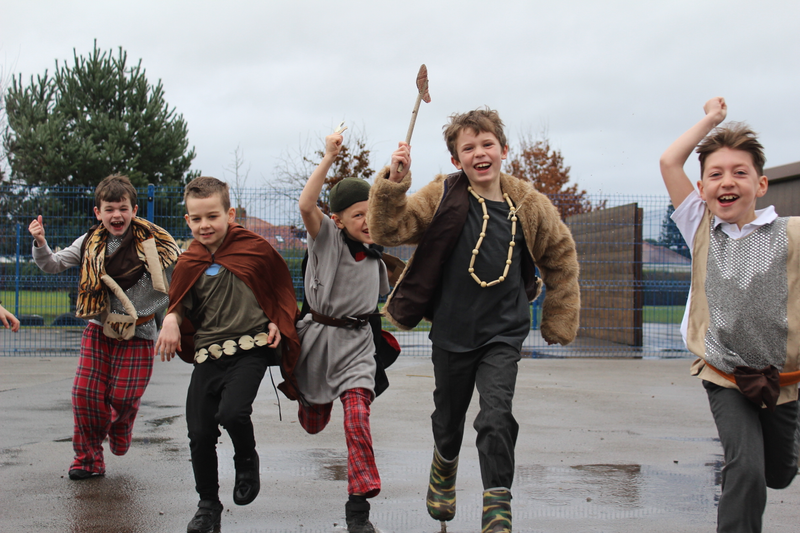
History is a subject that children love to learn and are very enthusiastic about. Alongside high quality lessons, we ensure that there are additional opportunities to enrich the History curriculum through curriculum assemblies, whole school assemblies, class trips and visitors.
Assessment in History is ongoing and formative. Teachers use questioning, retrieval activities, book work and end-of-unit outcomes, including the double page spread task, to assess pupils’ understanding of historical knowledge, concepts and vocabulary. This information is used to identify gaps, inform future planning and adapt teaching to ensure that pupils secure and deepen their understanding.
Implementation
History is planned and delivered across a two-year cycle using the Elevate framework as a model which ensures progression of both knowledge and skills across each year group. Cross-curricular links can often be made within planning, for example, in upper key stage two, within the Maya unit, links can be made to Geography with map work, writing linked with historical learning, telling mythical stories through dance and so on.
At the start of each history unit, there is a strong focus on chronology and the use of timelines which are on display in each classroom. Here, links to previous learning can be made to support retrieval practise. Links to geography can be made as children explore ‘when’ and ‘where’ in the world they are learning about and develop their coherent and concurrent historical understanding. Key vocabulary is discussed and explored with children and knowledge organisers are shared and referred to throughout units of learning to support understandings.
Disciplinary knowledge is defined as learning how historians have studied and analysed the past, and how they have constructed and presented accounts of the past. The areas of disciplinary knowledge taught are called second-order concepts. Each history unit has one or two focus second order concept(s). Examples of this include ‘cause and consequence’ and ‘change and continuity’. These are taught through school and allow children to become confident with these concepts and allow children to build on their understandings as they move through school and become more confident historians.
At Sowerby, we ensure that we support children with SEND by providing appropriate scaffolding within lessons as necessary and ensuring that all children have access to a wide range of learning opportunities. We often find that pupils with additional needs, thrive in History lessons where they can talk about subjects they have a passion for.
Children at Sowerby first experience History within the Early Years setting. This is as part of the ‘Understanding the World’ section of the EYFS framework.
By the end of EYFS, children will:
- Talk about the lives of the people around them and their roles in society.
- Know some similarities and differences between things in the past and now, drawing on their experiences and what has been read in class.
- Understand the past through settings, characters and events encountered in books read in class and storytelling.
Throughout KS1 and KS2 children now have their own History book which moves with them throughout school which really supports their ability to recall on prior learning. The books include knowledge organisers at the start of a unit which include key vocabulary which will feature in lessons to help reduce cognitive load for the children, and aid in their recall of key information. The organisers also include a timeline of events to support chronological understanding and a map so children can see where in the world they are focussing their learning. There is also a space for them to make connections to prior learning in the subject, or linked subjects. Books will all demonstrate the children’s growing understanding of the subject knowledge and skills they have developed over their time at Sowerby for them to reflect on, this is particularly evident within our ‘Flashback Friday’ sessions.
History is a subject that children love to learn and are very enthusiastic about. Alongside high quality lessons, we also ensure that there are additional opportunities to enrich the History curriculum through: Curriculum assemblies, whole school assemblies, class trips and visitors. We also ensure that there are planned opportunities for children to recall previously taught History learning for example through Flashback Friday and the use of knowledge organisers and mini-quizzes to revisit and revise.
Impact
The impact of our History curriculum at Sowerby Academy will be seen throughout school. Through pupil voice, children will be able to clearly articulate their historical findings and understandings they have acquired. Children are engaged in history lessons and show a positive attitude and enjoyment towards the subject. Through looking at books, work displays the range of skills and knowledge taught through topics and, where possible, cross-curricular links to further develop schema. It shows that children of all abilities are able to access the work set and that children have high expectations of themselves in their quality, presentation and understanding. Pupils increasingly think and work like historians: they ask historically valid questions, analyse evidence, make connections across periods of time and construct informed accounts of the past.
Through our carefully sequenced and inclusive curriculum, pupils leave Sowerby Primary Academy as confident, knowledgeable and reflective historians, well prepared for the next stage of their education.